

NAMEX NEWSLETTER | July 2026
CONSORTIUM
An increasingly Mediterranean summer
— By Maurizio Goretti, Namex CEO
This year, Namex’s summer is more Mediterranean than ever.
That is not just a turn of phrase. Over recent months the Mediterranean has become the thread running through many of the initiatives we are pursuing, and it stands out ever more clearly as one of the strategic directions along which we imagine the future of our consortium.
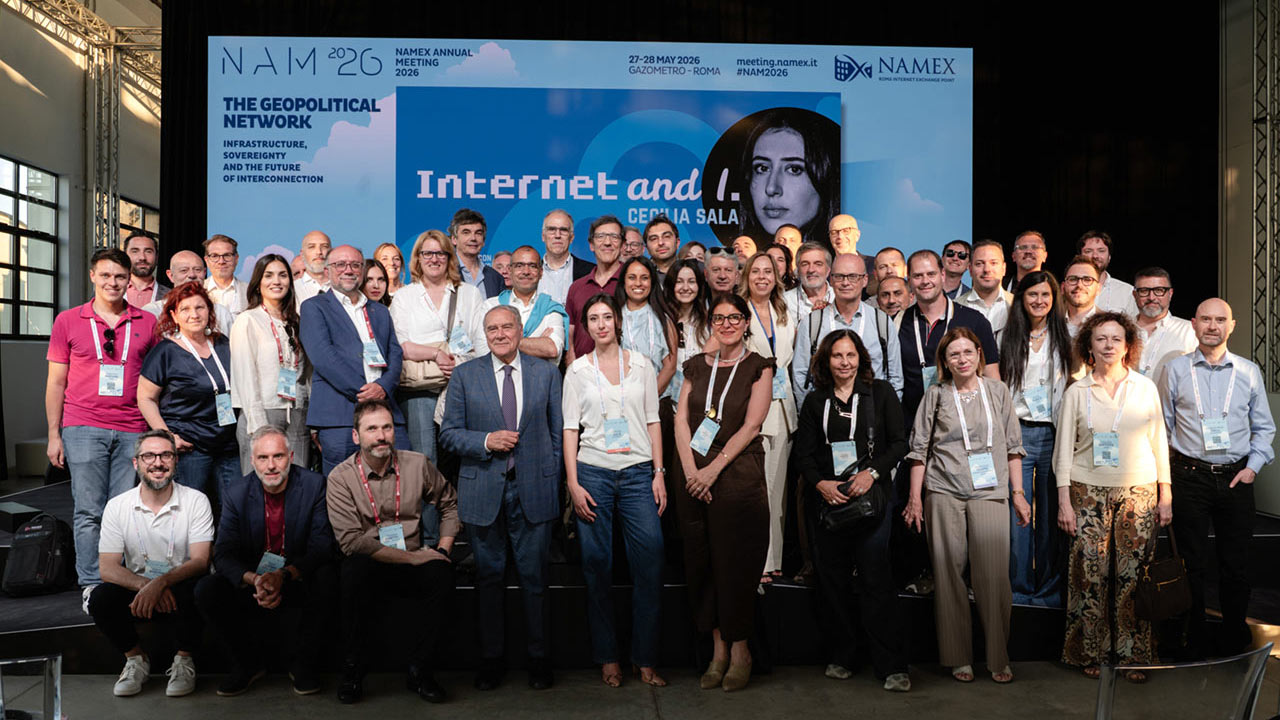
The success of NAM2026, which brought together almost a thousand participants — operators, companies, institutions and industry professionals — was the clearest demonstration of this. Not only because of the result itself, but because it confirmed once again the strength of the Namex community: a network of people who, every day, help build a more open, efficient and resilient internet.
For more than thirty years we have believed that cooperation between operators, neutrality and the sharing of expertise is the best way to help the internet grow. Today, in an international context marked by profound technological and geopolitical change, that conviction is more relevant than ever.
The Mediterranean is returning to the center of the internet’s geography. New submarine cables, data centers, digital infrastructure and new traffic flows are turning the region into one of the most dynamic parts of the global internet ecosystem.
NAM2026 · TECHNICAL WORKSHOPS
NAM2026, technical workshops at the heart of digital innovation
— By Flavio Luciani, Namex CTO and Marta Burocchi, Network and Systems Engineer at Namex
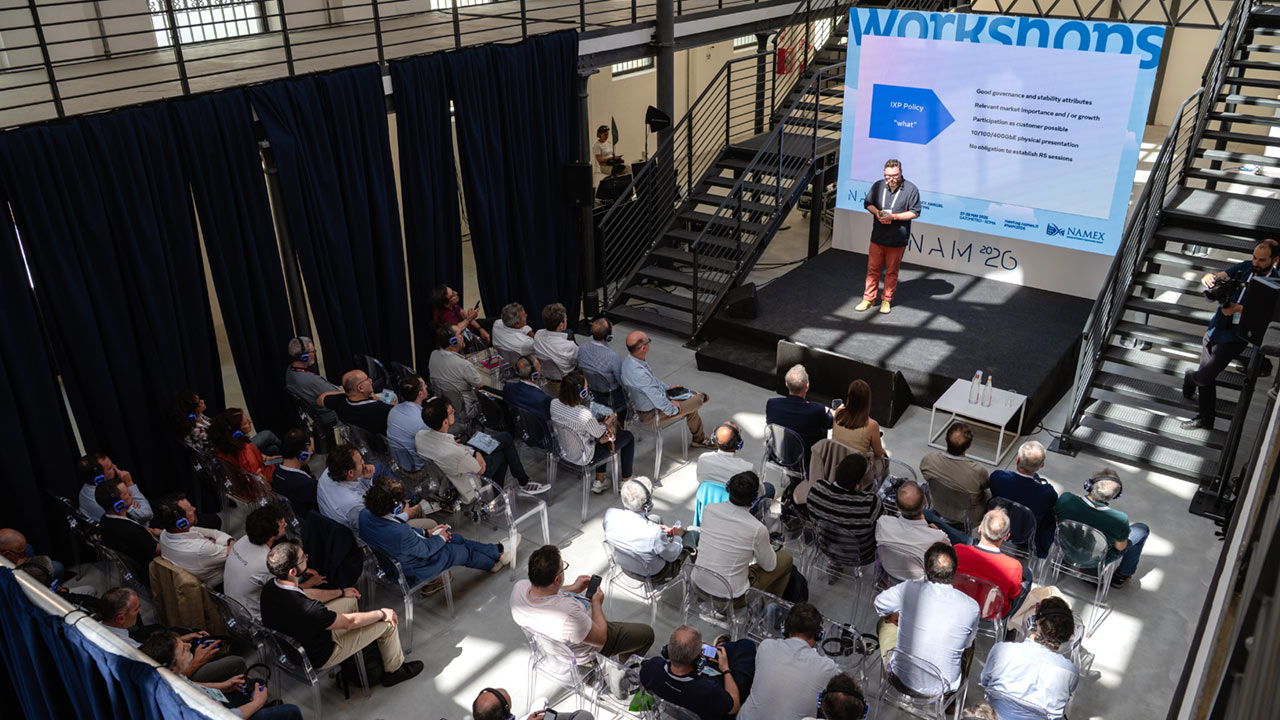
On May 27, the opening day of NAM2026, Rome’s Gazometro hosted an afternoon of workshops devoted to the changes reshaping telecommunications and digital infrastructure. Six sessions, run by companies and experts from the community, combined technical detail with reflection on where the market is heading.

PODCAST
Internet and I: live at the Gazometro with Cecilia Sala
— By Christian Cinetto, Head of Communication and Content at Namex
Namex’s new podcast makes its debut with a special guest at NAM2026.
The internet does not enter everyone’s life in the same way. For some it coincides with a first email, for others with a chat, a search, or the sudden sense that the whole world might pass through a screen at home. Even when we cannot remember our first time online, we often remember the moment we realized it would change something. It is from this personal memory that “Internet and I” the new podcast produced by Namex, sets out.
NAM2026 HIGHLIGHTS
NAM2026 by the numbers
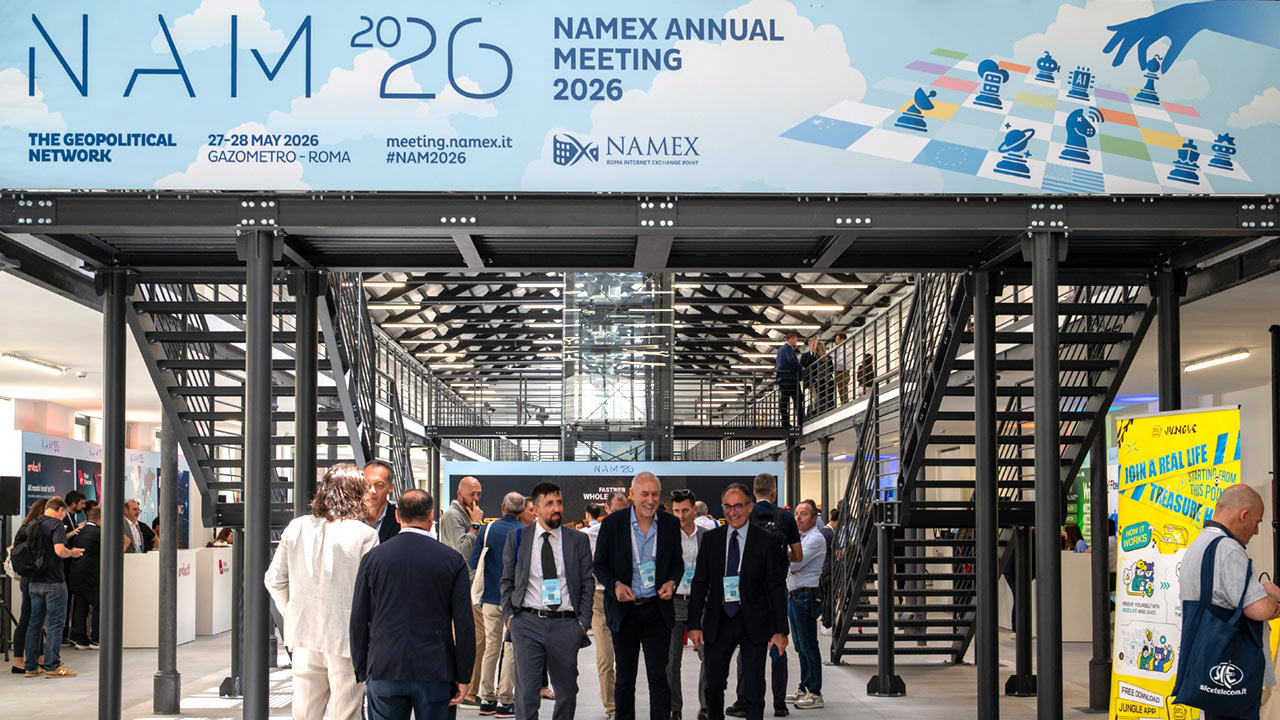
Two days at the Gazometro, 850 participants from more than 350 companies and institutions, and one question at the center of NAM2026: will the internet remain a single, open, global network?
There is a moment during the second day of NAM2026 when the hall at the Gazometro falls unusually quiet. On stage, Paul Vixie, one of the fathers of the DNS, is discussing the splinternet with Stefano Quintarelli and Maurizio Goretti: the possibility that the global network fragments into separate systems governed by different rules, interests and borders. Shortly before, Kentik’s director of internet analysis, Doug Madory, had shown what happens when governments decide to switch the internet off.

EUROPEAN DIGITAL SOVEREIGNTY
Politics has entered the internet without asking permission
Even the most distracted — or the most dreamy — now have to reckon with the evidence. And now even the pioneers acknowledge that we live in a different world, perhaps uglier than before; certainly grayer. The same dream, the same vital energy that gave rise to the network must now be directed elsewhere: toward building the foundations of a world in which the freedom of the network and the demands of geopolitics can coexist.
INTERVIEW
Those who build roads win, in the long run, over those who build walls
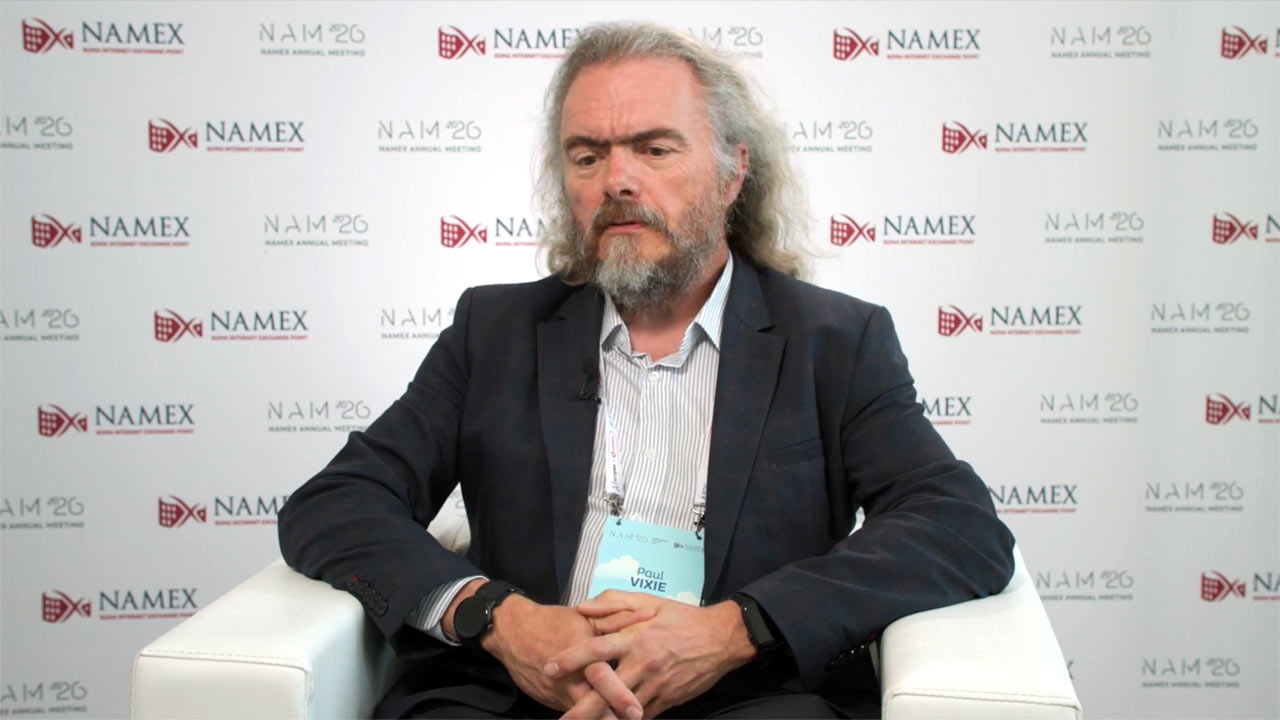
Interview with Paul Vixie, internet pioneer and Hall of Fame member, father of DNS
Paul Vixie — Internet Hall of Famer, “Godfather of DNS” — describes the fragmentation of the internet without nostalgia: control will grow, technology alone will not be enough, and the only realistic hope lies in the competition between those who connect and those who divide.
You are analyzing the splinternet phenomenon. Where is it heading? What consequences do you see, perhaps in the near future?
Well, I think there are a lot of activists who have always believed that universal connection was, or should be, a universal human right, and that the internet should never be blocked. I think that is naive. The reality is that every network is operated by some entity for some purpose. If there are types of traffic that are antithetical to that purpose — in my case, that might be spam — then I am going to block that traffic from entering the network I operate.
What is happening now is that the internet is part of daily life and part of the global economy. It is inescapable.
INTERVIEW
Europe doesn’t only need to innovate. It needs to learn to keep what it creates
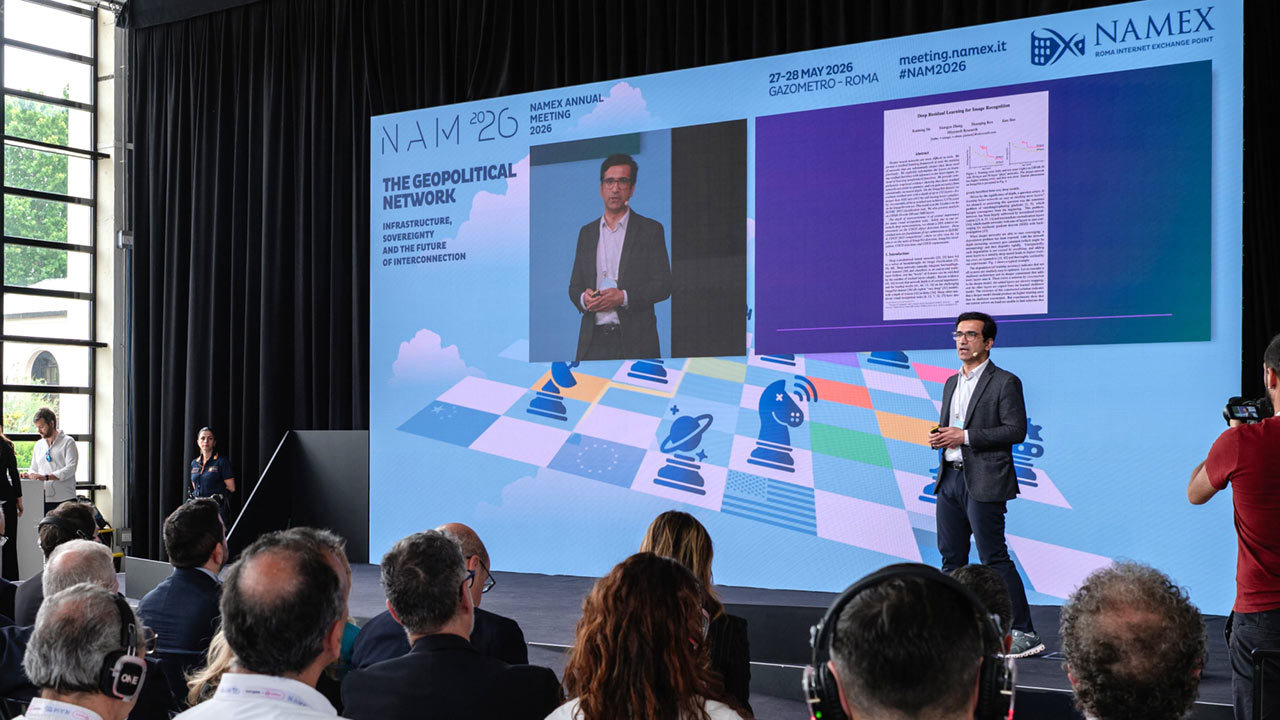
Interview with Mehran Gul, author of “The New Geography of Innovation”
Mehran Gul, author of “The New Geography of Innovation” and a speaker at NAM2026, explains why Europe’s lag in AI and frontier technologies is also a story of companies, capital and talent lost. The first challenge is not to produce more, but to stop what is born in Europe from growing up elsewhere.
The United States and China are racing ahead, and Europe is increasingly lagging behind. What are the main indicators of this problem for Europe?
So, I just talked in my presentation about, for instance, the world’s most important AI conference, which happens to be in Europe. If you look at the percentage of papers that were accepted from various institutions around the world, only 1% were accepted from an institution within the EU, and only about 4% from institutions in geographical Europe. That really shows you how the continent is positioned when it comes to competing in frontier areas.
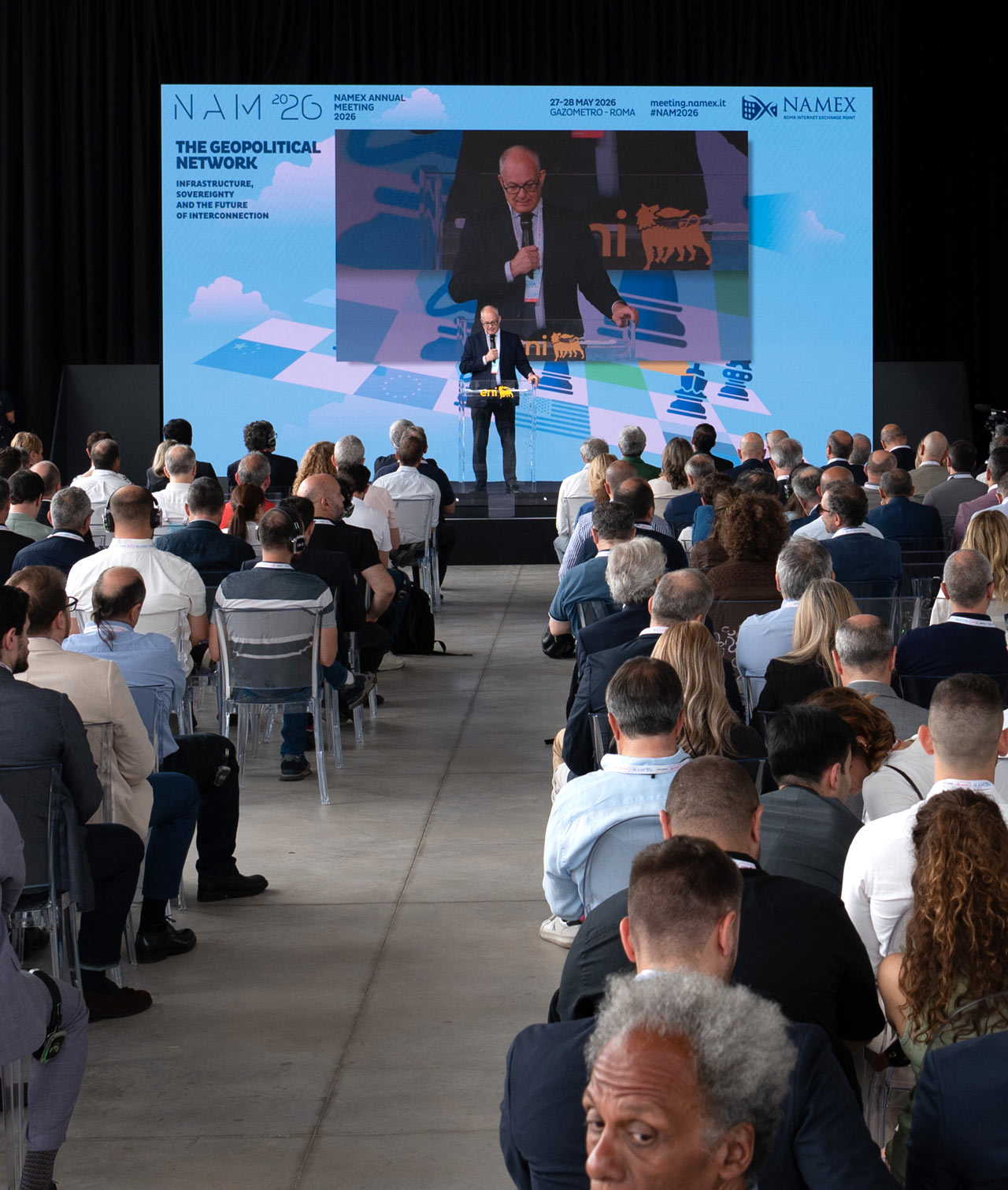
Photo of the Month
The mayor of Rome, Roberto Gualtieri, opens the NAM2026 plenary session.
[Photo © 2026 Margherita Mirabella]

AUGUST
25 august RMNOG, Roma
SEPTEMBER
11-14 september, IBC, Amsterdam show.ibc.org
13-16 september, EPF 19, Parigi peering-forum.eu/2026
15 settembre, RMNOG, Roma
24-26 september, Eurekalabria, Lamezia Terme www.eurekalabria.it/2026
BARI NOG (tba)
NEWS FROM NAMEX AND AROUND
News
Namex highlights
» INTERNET AND I: THE NAMEX PODCAST, WITH PIETRO GRASSO AND CECILIA SALA
We have given our podcast a home: the new namex.it/podcast section is now online. “Internet and I” tells the story of the network’s revolution through the personal accounts of those who lived it and shaped it — technology pioneers, political leaders, journalists and artists. Episodes include Pietro Grasso’s recollection of Giovanni Falcone’s password and “Se spegni internet spegni la guerra” (“Switch off the internet and you switch off the war”) with Cecilia Sala, recorded live at the Gazometro during NAM2026. Listen on Spotify and on all podcast platforms.
» NAMEX UNPLUGGED WITH ARTURO DI CORINTO
On July 21, at the regular gathering of the Rome Network Operators Group, the Namex Unplugged format brought the journalist and cybersecurity expert Arturo Di Corinto to the brewery to present his book “Guerra Profonda. Hacker, bugie e l’architettura segreta dei nuovi conflitti” (Luiss University Press x AGI). It was an informal chance to talk about security, conflict and network infrastructure in front of the community — confirming a formula that interconnects data and people alike.
» QUANTUM CRYPTOGRAPHY ON THE NAMEX NETWORK: THE ARGO ALLIANCE TRIAL
Argo Alliance, the federation between Namex and Top-IX — Italy’s two main non-profit internet exchange points — has successfully completed a demonstration of Quantum Key Distribution (QKD) on Italian networks, together with Adtran. The experiment, part of the Quid (Quantum Italy Deployment) project, linked two Namex data centers 30 kilometers apart in the Rome metropolitan area, validating the coexistence of a quantum channel with high-capacity traffic on the same fiber. “A clear signal of the direction in which telecommunications security is moving,” said Namex CEO Maurizio Goretti.
» NAMEX ON THE MAP OF ITALIAN DATA CENTERS
The geography of data centers in Italy continues to make news. An article published on July 21 in Agenda Digitale, by Gianluca Marcellino and Giuseppe Arcidiacono, examines how data centers are distributed across the country and the part they play in digital development, citing Namex among the key players in the interconnection ecosystem.
“Data center in Italia, la guida completa: quanti, quali e dove sono”
» MAURIZIO GORETTI IN WIRED: THE DIGITAL DEPTHS OF THE MEDITERRANEANSubmarine cables and the geopolitics of the network have also reached Wired, with a contribution from our CEO Maurizio Goretti. The article “Abissi digitali e assetti geopolitici nel Mediterraneo” considers how the invisible infrastructure running along the seabed — the internet’s “circulatory system” — has become a strategic asset, and Italy’s central role as a connectivity hub between Europe, Africa and the Middle East.
» NAMEX ON THE INTERNATIONAL TECHNICAL STAGE
Over the summer, Namex took its voice to the international technical community. On June 30 our CTO Flavio Luciani and network engineer Marta Burocchi represented Namex at GRNOG, the Greek Network Operators Group, in Athens, with the talk “Peering market at a glance.” On July 13 Flavio Luciani returned to the same theme at MNC2026, the IEEE International Symposium on Measurements in Networking and Communications, presenting “Peering Market at a Glance” to an audience of researchers and operators.
» AN IEEE PAPER ON NETWORK MEASUREMENT AND SECURITY
On the research front, a paper co-written by Namex with Sapienza University of Rome and the National Cybersecurity Agency (ACN) has been published on IEEE Xplore — a contribution that strengthens Namex’s role as a bridge between the operational world of networks and the academic and institutional one.
Follow all our updates on our social channels and on the Namex YouTube channel.
News from around the World
» DIGITAL SOVEREIGNTY IN ITALY: THE VOLTA FORUM IS LAUNCHED
The Volta Forum has been launched: a platform bringing together government, research and business around a specific goal — strengthening Europe’s and Italy’s ability to govern critical technologies, not merely to host them. The initiative, linked to the Volta Declaration, focuses on data centers, artificial intelligence, sovereign computing, high-performance computing and quantum computing as industrial and strategic levers.
“Italy does not intend to submit to a technological future designed by others, but to help build it. Technological sovereignty is not a slogan but a concrete strategy,” said Alessio Butti, undersecretary of state at the prime minister’s office with responsibility for technological innovation. He was speaking on the second day of the World Tech Conference in Milan, where he signed the protocol establishing the Volta Forum. Without secure infrastructure, computing capacity and control over enabling technologies, digital sovereignty is an empty goal. For Italy the stakes also take in telecommunications, cybersecurity, data management, energy and advanced manufacturing. Butti also has high hopes for the part Italy can play in the coming quantum computing revolution.
The Volta Declaration on quantum, artificial intelligence and sovereign computing infrastructure brings together the government, the CNR (National Research Council), the National Quantum Science and Technology Institute, the Q-Alliance, businesses and technology partners. According to CNR president Andrea Lenzi, Italy has for the first time a complete quantum supply chain, from scientific research through to industry.
Read more
» €8 BILLION FOR DATA CENTERS IN LOMBARDY AND PIEDMONT, WITH SPECIAL COMMISSIONERS
The council of ministers has declared two new data center investments in Lombardy and Piedmont, worth around €8 billion in total, to be of “pre-eminent national strategic interest.” The decision, proposed by the minister for enterprise and made in Italy, Adolfo Urso, triggers the procedure set out in article 13 of the Asset Decree and will lead to the appointment of two special government commissioners, one for each program, in agreement with the regions.
The “Equinix for Italy” project provides for seven new data centers between Settimo Milanese and Cusago, with €4 billion of investment between 2026 and 2033. The “Cavour Hyperscale Campus” will instead convert the former Galileo Ferraris power station at Trino, in the province of Vercelli, with a further €4 billion and expected capacity of 300–400 megawatts.
The commissioners will be responsible for coordinating the authorities involved, speeding up permits and shortening delivery times for infrastructure regarded as decisive for AI, cloud and digital sovereignty.
It is a step forward by the government on a subject of strategic importance for the country, but one taken within a regulatory framework that is still incomplete. The national data center bill has not been approved, and the question of a comprehensive set of rules — capable of reconciling investment, energy consumption, land-use planning and simpler permitting — remains open. Appointing special commissioners answers the need to accelerate projects deemed to be priorities, but it makes the case for stable rules, predictable procedures and criteria agreed between central government, the regions and local authorities all the more obvious.
Read more
» SUBMARINE CABLES: FROM THE HORMUZ RISK TO THE GREENMED ALTERNATIVE
Tensions in the Strait of Hormuz are a reminder — to a wider public than industry insiders alone — that global connectivity depends not only on the cloud but on vulnerable physical infrastructure: submarine cables, landing points, shipping lanes and terrestrial backbones. During the conflict, growing risk was reported to telecom cables in the Hormuz area, while in the Mediterranean an infrastructure response is taking shape: GreenMed, the submarine cable system promoted by Sparkle with Alcatel Submarine Networks and Elettra Tlc.
The project aims to strengthen diversification, resilience and low latency between Europe and the Middle East, crossing the Adriatic and connecting Italy, the Balkans, Greece, Turkey and the eastern Mediterranean. For Italy it is another building block in its positioning as a Mediterranean digital hub.
Read more
» SATELLITES AND MOBILE: AMAZON AND SPACEX RAISE THE STAKES
Competition in satellite connectivity is becoming (even) more aggressive. According to press reports, Amazon is close to acquiring Globalstar for around $11.6 billion, a move that would sharpen its challenge to Elon Musk’s SpaceX and its Starlink subsidiary, and open up new possibilities in direct-to-device services — services delivered straight to the user, with no mobile operator required. On the other side, SpaceX is already considering launching a retail Starlink mobile service of this kind in the United States, aimed directly at consumers. It could even build its own terrestrial network, competing head-on with Verizon, AT&T and T-Mobile. Its $17 billion deal with EchoStar for wireless spectrum reinforces that trajectory. One consequence would be a further extension of US big tech’s footprint into national markets.
Read more