
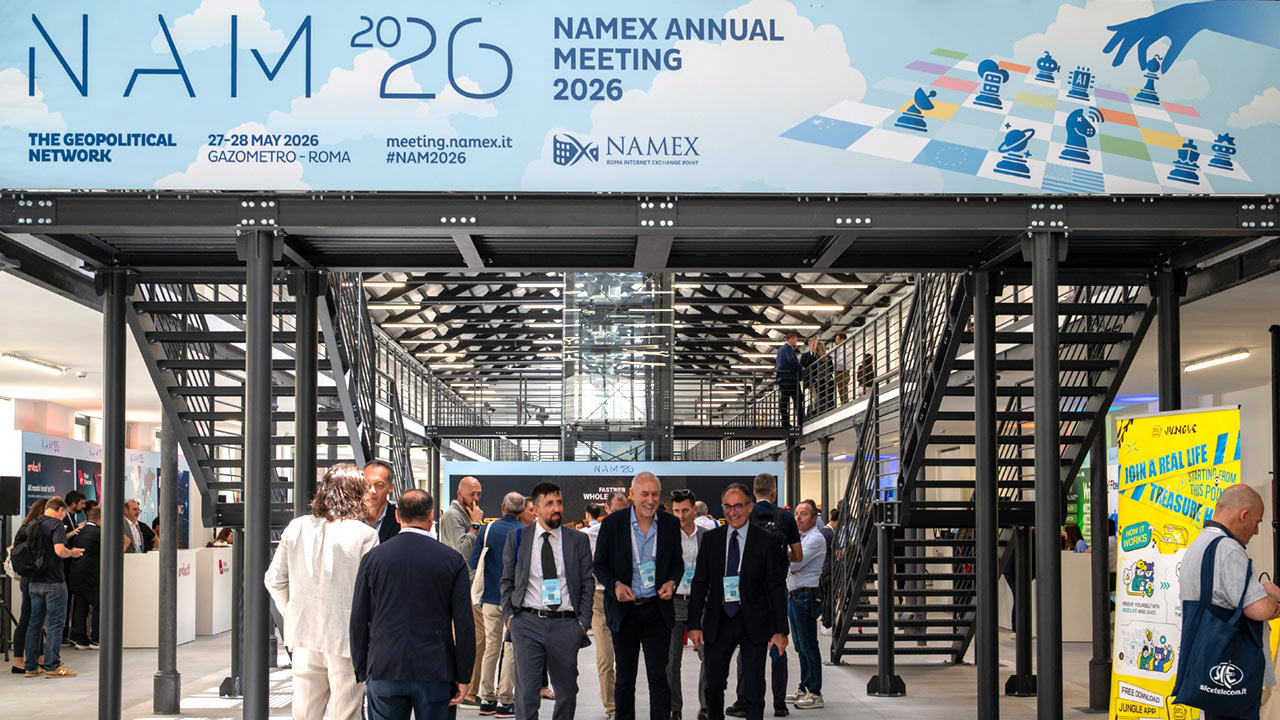
Two days at the Gazometro, 850 participants from more than 350 companies and institutions, and one question at the center of NAM2026: will the internet remain a single, open, global network?
There is a moment during the second day of NAM2026 when the hall at the Gazometro falls unusually quiet. On stage, Paul Vixie, one of the fathers of the DNS, is discussing the splinternet with Stefano Quintarelli and Maurizio Goretti: the possibility that the global network fragments into separate systems governed by different rules, interests and borders. Shortly before, Kentik’s director of internet analysis, Doug Madory, had shown what happens when governments decide to switch the internet off.
“The Geopolitical Network: Infrastructure, Sovereignty and the Future of Interconnection” was the title of the first Namex Annual Meeting to run across two days. The format made it possible to set technical discussion alongside a broader reflection on the future of the network.
For a long time we described the internet as a global, open, borderless infrastructure. Today it is also one of the territories over which sovereignty, political influence, economic control and strategic competition are exercised.
DAY ONE: THE WORKSHOPS AND CECILIA SALA
The opening day was devoted mainly to operators and technology.
Six workshops addressed the future of the wholesale market, the development of edge infrastructure, the strategic networks underpinning the national electricity system, AWS peering, and the architecture designed to support the Milan Cortina 2026 Winter Olympic and Paralympic Games.
Running alongside them were the One-to-One meetings: direct conversations between companies, operators and organizations, and one of NAM’s most practical and most appreciated features.
In the late afternoon the program changed register. Christian Cinetto and Cecilia Sala recorded the first episode of “Internet and I,” the new podcast produced by Namex, in front of the audience. It was a conversation about a personal relationship with the internet, but also about the role connection plays in today’s conflicts: a tool of information, of control and, in some cases, of survival.
The day ended with dinner in the grounds of the Gazometro, once again an integral part of the event’s identity. The illuminated Gazometro was a sight to behold.
DAY TWO: THE NETWORK AS A POLITICAL QUESTION
The plenary session brought together representatives of government, industry, research and journalism.
Mehran Gul, author of “The New Geography of Innovation,” opened the program with a reflection on the new geography of technological innovation.
The European debate brought Lucrezia Busa of the European Commission to the same table as MEPs Francesco Torselli and Nicola Zingaretti, moderated by Innocenzo Genna: a cross-party dialogue on infrastructure, strategic autonomy and EU digital policy.
Paolo Gentiloni, the former prime minister and European commissioner, interviewed by Roberto Inciocchi, addressed digital sovereignty and the role of politics. Doug Madory analyzed network shutdowns. Paul Vixie and Stefano Quintarelli discussed the risk of a progressive fragmentation of the internet.
The program then returned to industry, with Fastweb, Namex, Open Fiber, Retelit and Unidata, before an update on Namex’s activities and projects presented by Maurizio Goretti and Flavio Luciani.
The day closed by looking beyond Earth, with a talk by Emilio Cozzi on the geopolitics of space, and by considering how journalism tells the story of infrastructure that is often invisible yet decisive for the functioning of society, with Alessandro Longo and Mila Fiordalisi.
NAM2026 BY THE NUMBERS
NAM2026 brought together more than 850 unique participants from over 350 companies, institutions and organizations.
The event was supported by 36 sponsors:
- 1 Diamond sponsor
- 4 Platinum sponsors
- 16 Gold sponsors
- 6 Silver sponsors
- 9 Bronze sponsors
Between May 25 and June 4, press coverage amounted to 39 pieces, with articles and analysis devoted to the political, industrial and technological themes that emerged over the two days. Among the outlets were Repubblica, Agenda Digitale and an Adnkronos special on the industry panel.
The most important figure, though, is a qualitative one. For two days, network operators, institutions, businesses, researchers and journalists discussed the internet as an infrastructure whose future depends on the choices we are making today. The question NAM2026 opened with — whether we will continue to have a single, open, shared network, or a set of internets separated by strategic rivalries — remains open, and we now face it with greater awareness than before.