

NAMEX NEWSLETTER | february 2026
CONSORTIUM
The Internet is changing. IXPs remain central.

— By Maurizio Goretti, Namex CEO
For years, Internet Exchange Points have been one of the most visible success stories of the “bottom-up” Internet: neutral, community-based infrastructure capable of reducing interconnection costs, improving the performance of local networks, and fostering the growth of national and regional digital ecosystems. Today the context is changing rapidly, and a provocative question lurks in the background: have IXPs already lived their great future, or do they still have one ahead of them?
In recent months, several analyses from the international community, including the recent contribution by Flavio Luciani together with John Souter, have offered a particularly stimulating reading of the ongoing evolution in the interconnection ecosystem. Far from simplistic narratives about the “decline” of IXPs, these reflections reframe the role of Internet Exchange Points in light of the new transformations taking place across the Internet: greater traffic concentration, new interconnection models driven by large global platforms, and increasing complexity in connectivity value chains. The article also highlights how the major hyperscalers are assuming, by weight and bargaining power, a role not entirely unlike the one traditionally held by Tier-1 carriers: central actors in the ecosystem, but increasingly less interested in the dynamics of open public peering. In this scenario, IXPs do not lose centrality, but they are called upon to evolve their role, strengthening their position as neutral platforms in service of local communities, network resilience, and the diversification of interconnection ecosystems.
This role becomes even more relevant when viewed through the lens of digital sovereignty: ensuring that local traffic stays local means reducing external dependencies, improving the performance and reliability of services, and contributing to greater autonomy for regional digital ecosystems.

ARTICLE of the month
Why IXPs still matter, but in a different way
— By Flavio Luciani, Namex CTO
In recent years, there has been a persistent narrative that Internet Exchange Points are losing relevance: slower growth, fewer new members, traffic shifting toward private interconnects, in-network caching, and alternatives to public peering. This perception, however, is often based on oversimplified metrics and fails to capture how the interconnection ecosystem is truly evolving.To better understand what is actually happening, we, together with John Souter and with the support and contributions of several experts from the peering and interconnection community, have produced an analysis titled Peering Market at a Glance.

REGULATORY POLICIES
Telecom consolidation in the EU: What Has Changed After von der Leyen’s Statements
— By Innocenzo Genna, Legal specialist in EU digital policy, competition and liberalization regulations
The recent statements by President von der Leyen on a possible “relaxation” of antitrust rules on mergers have sparked considerable interest in financial circles, which have long called for greater market concentration to reduce competition and recover some margin. The issue of financial and industrial sustainability in the telecom market has always been hotly debated, but it is sometimes driven by generic narratives and unsubstantiated analyses.

GEOPOLITICS OF THE INTERNET
A fine that could break the Internet in Italy
— By Christian Cinetto, Head of Communication and Content at Namex
The standoff between AGCOM and Cloudflare is far more than a fine: it is the first stress test over who controls the network in the post-DSA era.
Matthew Prince, CEO of Cloudflare, chose to accompany his declaration of war on the Italian regulator on X with an AI-generated image that went viral: a medieval knight brandishing an Open Internet flag, surrounded by figures in suits with stereotypically Mediterranean features and Roman gladiators with the Colosseum in the background. Not subtle, not elegant, but effective for a certain audience.

BALKANS
ANIX Meeting 2026: Tirana, hub of the Balkans
— By Daniele Arena, Peering developer at Namex
The ANIX Meeting 2026, organized by Namex and RASH in Tirana on February 5, confirmed a key point: in the Balkans and beyond, digital cooperation is not built on a single infrastructure or a single project, but through a harmonization of rules, infrastructure, regional cooperation, and expertise, driven by the Internet community. With 74 in-person attendees and 66 streaming participants, the event brought together ISPs, institutions, technical communities, and international stakeholders around a shared question: how to make local and regional interconnection more efficient and sustainable.
NAMEX OBSERVATORY
Observatory: new traffic record at Namex Bari
— By Flavio Luciani, Namex CTO
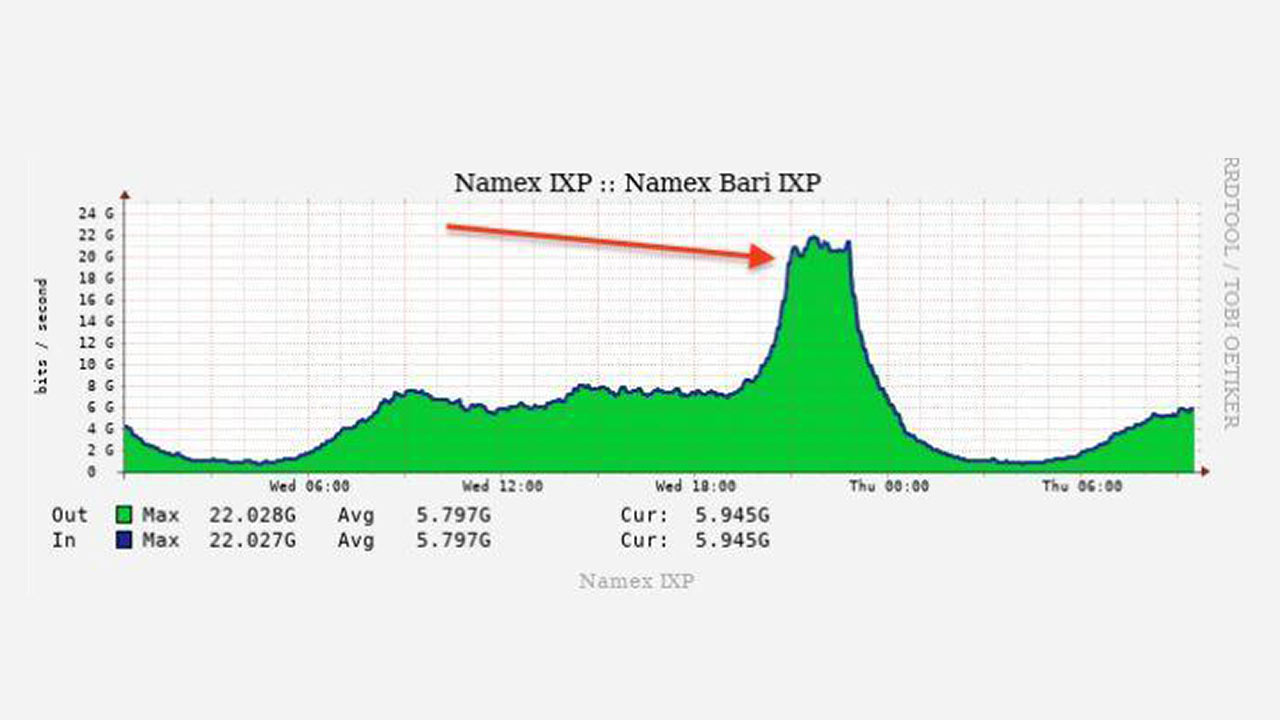
During a recent Champions League match between Bodø/Glimt and Inter, we recorded a new traffic peak at Namex Bari, exceeding 20 Gbps. This milestone confirms the solid and steady growth trend already underway at the node, both in terms of connected Autonomous Systems and overall traffic volumes. Major live sporting events have once again proven to be powerful drivers of Internet traffic, underscoring the strategic importance of local interconnection infrastructure.

STORY of the month
Convergenze
he digital and economic future of a territory can begin right next to the vestiges of a great past. “November 25, 2005: Convergenze is born, one kilometer from the ruins of Paestum. Mission: to reduce the digital divide in the Cilento area,” explains Rosario Pingaro, the provider’s founder and CEO. It started with wireless broadband service and then evolved to offer a range of “convergent” products spanning telecoms (including a proprietary fiber optic network), energy, TV, communications, and virtualization. Now also an MVNO.

INTERVIEW
AI according to Antonio Baldassarra
Interview with Antonio Baldassarra, CEO Seeweb and DHH
— By Alessadro Longo, journalist
Antonio Baldassarra now looks at AI the way someone who has already lived through a major tech revolution: the cloud revolution. It is a perspective worth having. It helps one imagine the shape artificial intelligence will ultimately need to take for those of us who, like Italians, do not create this technology at the foundational level.
The founder of Seeweb, an Italian cloud provider, recalls what the mood was like in 2010, the years when cloud still seemed like a bet, not the invisible infrastructure now underpinning nearly everything digital, AI included. “We are facing a technological leap that will define the next ten, twenty years, just as that one did,” he says. The difference is that today, on artificial intelligence, he believes we are running in the wrong direction.
History, once again, provides lessons. Seeweb, his creation, was founded in 1995 as an Internet provider, back when connectivity meant the screech of a modem and the web was still frontier territory. First an ISP, then web hosting in 1998, then cloud in 2009: “We were among the first Italians to do it, modeling ourselves on AWS and GoGrid, which were the American pioneers at the time.” It is a story of infrastructure: servers and data centers built piece by piece as the network grew around them.

Monthly Photo
First Namex Unplugged event
A conversation space bringing together the Namex community and those trying to make sense of where the Internet is heading, through books, podcasts, and research. On February 17, the featured guest was Riccardo Luna, who presented his book Qualcosa è andato storto.

MARCH
17 March RMNOG, Roma
22-23 March Peering Days, Bologna
27 March MEDITERRANEAN DATA CENTER FORUM, Bari
APRIL
14 April RMNOG, Roma
20-21 April ITNOG 10, Bologna
21-22 April SEE14, Belgrado
News
News from Namex and around
Namex highlights
» ANIX Meeting 2026: Tirana, a New Digital Hub?
On February 5, Tirana hosted the annual ANIX Meeting, the gathering centered on Albania’s only neutral Internet Exchange Point. More than 100 participants from 57 organizations discussed cross-border digital cooperation and infrastructure development in the Balkans. Namex’s role in managing ANIX was also featured in Wired, as part of a broader article on the submarine cable network reshaping the digital geography of the Mediterranean.
More
» Namex Unlugged: A New Format for the Community
On February 17, ahead of the usual informal gathering of the Rome Network Operators Group, the first Namex Unplugged. event was held in Rome: a format for discussing the interconnection of data and people, and for exploring the Internet from its physical infrastructure to its social implications. Journalist and science communicator Riccardo Luna presented his book, followed by a conversation with journalist Alessandro Longo and Senator Antonio Nicita, in front of a highly engaged audience.
» Shareholders’ Assembly: 2025 Financial Report Approved Unanimously
On February 26, the ordinary assembly of Namex member organizations was held in Rome. It is one of the annual milestones structuring the life of the consortium: an opportunity to share results, validate directions, and reinforce the sense of belonging to a collective project. One year ago, at the same venue, the new Board of Directors was sworn in. Members and their delegates unanimously approved the excellent final financial results for 2025 and the projected budget for 2026.
» Namex Traffic Record: 1.474 Tbps
Our observatory recorded a new traffic peak during the Juventus vs. Benfica match on January 21. One year after surpassing the first terabit per second, traffic continues to grow at a pace that places Namex among the most significant IXPs in Europe.
» Toward NAM 2026: May 27–28, Rome, Gazometro
The focus on the future of the Internet, spanning geopolitics, critical infrastructure, and new technological frontiers, reflects the growing need for coordination among operators, territories, and institutions. A new format awaits, and we look forward to seeing everyone at the Gazometro.
Follow updates on our channels or write to us at meeting@namex.it
» Namex YouTube: The Channel Keeps Growing
The Namex YouTube channel continues to be updated with talks, interviews, and in-depth features. A living archive for those who want to explore at their own pace the topics we summarize on other social channels. You will find, in particular, the full recordings of the Spazio, Anix and Namex Unplugged events.
Internet World News
» Submarine Cables: Sparkle Launches GreenMed in the Mediterranean
The race to build resilience into Mediterranean submarine backbones takes a significant step forward with GreenMed, the new cable system announced by Sparkle together with Alcatel Submarine Networks and Elettra Tlc. The cable will create a new high-performance corridor between the Levant and Milan, passing through Sicily and Crete, to reduce dependence on more exposed routes such as the Red Sea and Suez. GreenMed will adopt an “open cable” model allowing each customer to customize the optical architecture and capacity. The goal is to increase redundancy and path diversification in a region where cable faults remain frequent. ITU and ICPC experts note that annual faults still number around 200, with more than 80% caused by human activity such as fishing and anchoring. The issue has now taken on institutional scale. Europe is preparing a “Cable Security Toolbox” and a dedicated fund of €347 million for infrastructure protection (€60 million in 2026 tenders for cable repair modules, €20 million for “smart” systems, sensors and cable monitoring, and €267 million in CPEI tenders between 2026 and 2027). This is happening as Italy seeks to consolidate its role as a hub for traffic between Europe, Africa, and the Middle East, with Rome as one of the main Mediterranean interconnection nodes for global cloud providers and other countries.
More
» Mediterra Acquires Open Hub Med: Sicily as a Data Hub
With the acquisition of Open Hub Med in Carini (Palermo), Mediterra DataCenters strengthens its vision of a regional data center platform across Southern Europe. The site, Sicily’s only carrier-neutral data center, is powered at 2 MW and is less than one kilometer from the coast, near the main submarine cable landing points: a position that makes it a natural exchange node between backbones from Africa, the Middle East, and Asia and the European networks. The operation aims to transform Carini into a strategic node for data traffic and colocation services, with space and power expansions already planned. According to CEO Emmanuel Becker, investing in “premium” infrastructure in Sicily means enabling the digital transformation of public administration and local businesses, while offering major global players low latency and high resilience. The acquisition follows that of Cloud Europe at Rome’s Tecnopolo Tiburtino, and signals further moves ahead in the Mediterranean area.
More
» AI Readiness: The ITU Builds a Metric for Telecom
Understanding whether a country is genuinely ready for artificial intelligence is becoming possible on a more objective, standardized basis. The International Telecommunication Union (ITU) has updated its “AI Ready Report 2.0,” defining a framework of comparable metrics to measure infrastructure, data, skills, governance, and standards. The goal is to help governments and businesses identify gaps, starting with the 5G shortfall that is holding back many advanced use cases. For telecoms, this means that investing in networks and data centers is not enough. Policies on data quality, in-house training, and clear rules on security and accountability are also required. The ITU framework provides a structured “check-up” that allows countries to compare progress and guide incentives and regulation. Those who fall behind on readiness risk losing competitiveness precisely as AI enters network processes, traffic management, and customer services.
More
» The “Cable Graveyard”: The Hidden War on the Seabed
The Mediterranean is an increasingly critical crossroads for global traffic, yet policymakers’ eyes remain fixed on the sky. A paradox, given that 99% of internet traffic travels via submarine cable and the Mediterranean is gaining in strategic importance. The space economy is undeniably strategic, but it is worth putting things in perspective, as a feature in Il Giornale dei Marinai reflects, describing our sea as a “cable graveyard” (“The invisible war running along our seabed”). Underwater, hundreds of millions of dollars in infrastructure intersect with new risks: sabotage, espionage, and suspicious incidents that can isolate entire regions. Ignoring the importance of the cables running through the Mediterranean is tantamount to underestimating these risks. Italy is a bridge between three continents: landing stations such as Mazara del Vallo, Palermo, Bari, and Savona host strategic systems including Blue-Raman and SeaMeWe-6, with onshore facilities that are effectively national critical assets. There are many operational vulnerabilities: currents that expose cables, trawl nets that damage them, dense maritime traffic near landing points. A key challenge going forward will be reconciling backbone security, maritime activities, and environmental protection in one of the most heavily trafficked seas on the planet.
More
» Satellite Internet: The Real Challenge Is the Launch Supply Chain
Satellite internet access is moving beyond its niche as a last-mile service for remote areas. A recent Ookla report indicates that low-earth orbit constellations have changed the perception of the service, with performance now adequate for video conferencing and gaming thanks to reduced latency. SpaceX, with Starlink, has become the sector benchmark for launch frequency and continuous constellation updates, forcing competitors to play catch-up. In Speedtest Intelligence tests on Viasat, Italy ranks among the most represented non-US markets, a signal of significant domestic demand. The competitive game is increasingly being played at the level of the industrial launch supply chain: access to reliable launch vehicles, cost per kilogram to orbit, and the ability to replace satellites quickly. Whoever controls this chain will be able to offer lower prices and higher quality, with knock-on effects on terrestrial network backup and enterprise mobility and connectivity services.
More
» Eutelsat: One Billion for OneWeb Satellites
The Eutelsat group has secured approximately €1 billion in export credit financing, backed by French state guarantees, for the supply of new low-earth orbit satellites for the OneWeb constellation. The package supports a contract with Airbus for the construction of 340 satellites, subject also to a bond issuance by Eutelsat Communications. The deal confirms the industrial bet on the LEO model for global connectivity services, complementary to or a substitute for terrestrial networks in certain areas. For Eutelsat, which integrated OneWeb following a complex merger, the financing is critical to completing the next-generation constellation and strengthening its position in a market where competition from Starlink is already aggressive, across both consumer and enterprise segments.
More
» Digital Networks Act: Internet Society against “Fair Share”
In the debate over the EU’s upcoming Digital Networks Act (DNA), the Internet Society has renewed its criticism of “fair share” proposals calling on large content and application providers to contribute to network costs. In its latest intervention, the organization reiterates that there is no evidence of a market failure in IP interconnection, nor of systemic “free riding” by platforms. According to Internet Society, BEREC studies show competitive markets and already extensive collaboration between carriers, content providers, and CDNs. Introducing mandatory cooperation mechanisms or frameworks for future payments into the DNA risks creating a regulatory structure in search of a problem, with side effects on net neutrality and the fragmentation of the global internet. Internet Society warns that imbalanced legislation could rigidify investment incentives and weaken the open model that has enabled the development of today’s backbones and platforms.
More
» Wikimedia at the UN: Digital Public Goods and Open Governance
Projects such as Wikipedia and Wikidata are information infrastructures that deserve protection: built by volunteer communities and made available as an open resource for education, innovation, and civic participation. This was the message the Wikimedia Foundation brought to the United Nations General Assembly at WSIS+20 (World Summit on the Information Society 20-Year Review), presenting the foundation’s vision for the role of digital public goods in internet governance. The organization calls on future regulatory frameworks, national and international, to actively recognize and support these community-led platforms. Through the intervention of Public Policy Director Jan Gerlach, Wikimedia urges states to defend the multistakeholder model that emerged from the World Summit on the Information Society, in which governments, civil society, the private sector, and technical communities share responsibility for the rules of the network. “We must ensure that those leading global digital governance understand how and why digital commons are essential for a healthy and equitable online information ecosystem,” said Gerlach.
More
» Cloudflare Challenges AGCOM: The Risk of Automatic Blocks
The appeal announced by Cloudflare against the €14 million fine imposed by AGCOM reopens the Piracy Shield case, the anti-piracy platform established by Law 93/2023. According to the US company, the system, which requires the activation within minutes of automatic blocks on domains and IP addresses, risks hitting legitimate services and creating “indiscriminate blocks” affecting significant portions of the Italian network. Cloudflare also contests the size of the penalty, which it considers disproportionate relative to its Italian turnover, and fears a precedent that could discourage the presence of international operators. On the other side, the proponents of the legislation defend the system’s effectiveness in combating sports piracy and illegal IPTV services, citing tens of thousands of domains disabled. The dispute, increasingly political and diplomatic, touches a delicate issue: how to balance copyright protection, due process guarantees, and the technical integrity of the internet.
More
» Italo Brings Starlink to Its Trains: Tests Reach 400 Mbps
Italian rail operator Italo (NTV) has signed an agreement with Starlink satellite service to bring satellite connectivity to its entire high-speed fleet, a world first for an operator of this size. Tests conducted on trains traveling at 300 km/h recorded speeds above 400 Mbps and latencies of around 25 milliseconds, with 85% of passengers involved reporting full satisfaction. The service will be introduced from mid-2026 and completed in 2027, with the goal of overcoming the typical drop-outs on tunnel sections or areas with poor mobile coverage. For Starlink, the deal represents an important use case in mobility, following trials in maritime and aviation settings; for Italo, it is a direct competitive lever on on-board comfort in an increasingly crowded high-speed rail market that is paying growing attention to digital service quality.
More