
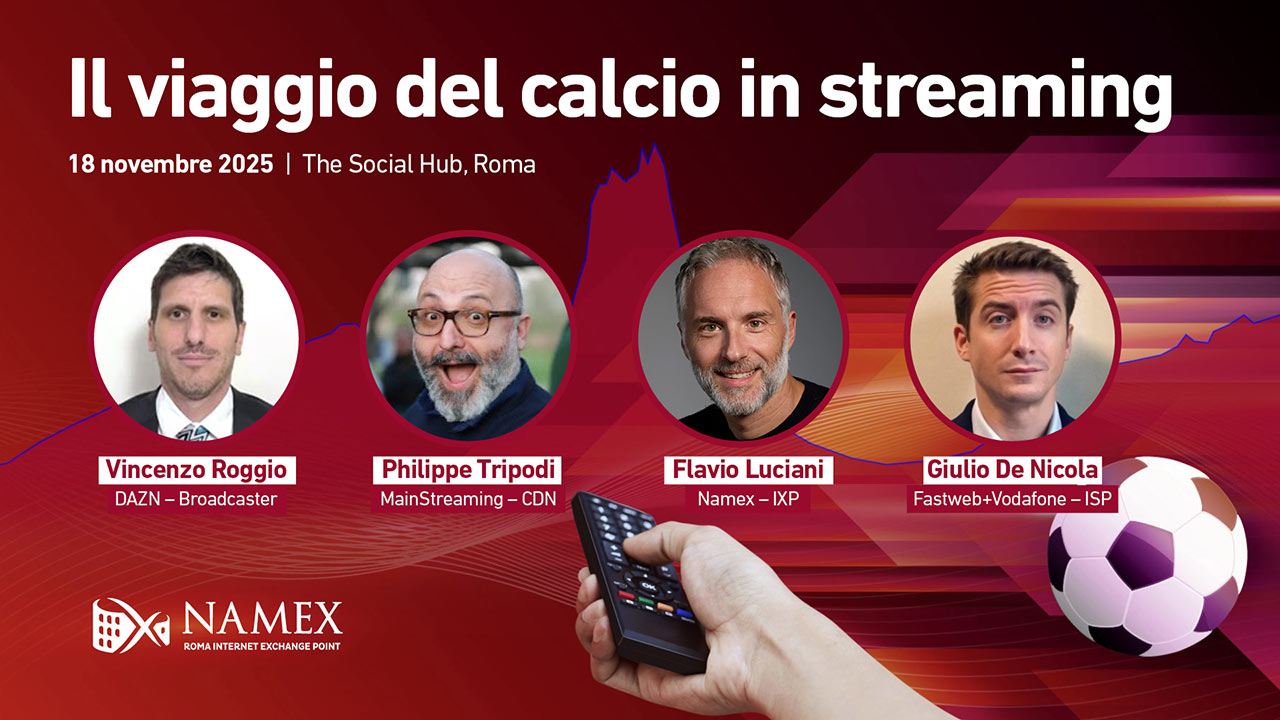
What happens behind the scenes on our network when the Serie A whistle blows? At the Rome NOG (Network Operators Group) in November 2025, the entire supply chain of operators distributing streaming soccer gathered to tackle one of modern telecommunications’ most complex challenges. The panel offered a unique perspective, bringing all the links in the chain to the same table: the broadcaster (DAZN), the distribution platform (MainStreaming), the Internet Exchange Point (NAMEX), and the network operator (Fastweb).
A team effort: from source to end user
A successful live stream doesn’t depend on a single factor. It requires perfect synchronization among four key players: the broadcaster, which holds the rights and produces the signal while managing peaks of millions of simultaneous users connecting at the same instant; the CDN, the technology that packages and distributes the video stream, optimizing it to minimize delays and maximize quality; the IXP, essentially the “airport” where networks meet, crucial for keeping traffic local and avoiding national bottlenecks; and finally the ISP, the operator that delivers the last mile of connectivity into Italian homes, ensuring that the final “pipe” can handle the traffic surge.
The discussion focused particularly on the battle against latency and the annoying “spoiler effect,” when your neighbor cheers before you see the goal. The objective: bringing IP streaming up to the performance level of traditional broadcast television through edge computing, which moves content closer to users and shortens the data path. Ultimately, the NAMEX gathering confirmed that the future of streaming soccer depends on collaboration across the entire supply chain: those who produce the content, those who distribute it, and those who deliver it to end users, all working together to ensure an increasingly smooth and reliable experience.
The full video of the event is available here: https://www.youtube.com/watch?v=NxZ86_NGyAw&t=4741s
— By Flavio Luciani, Namex CTO