
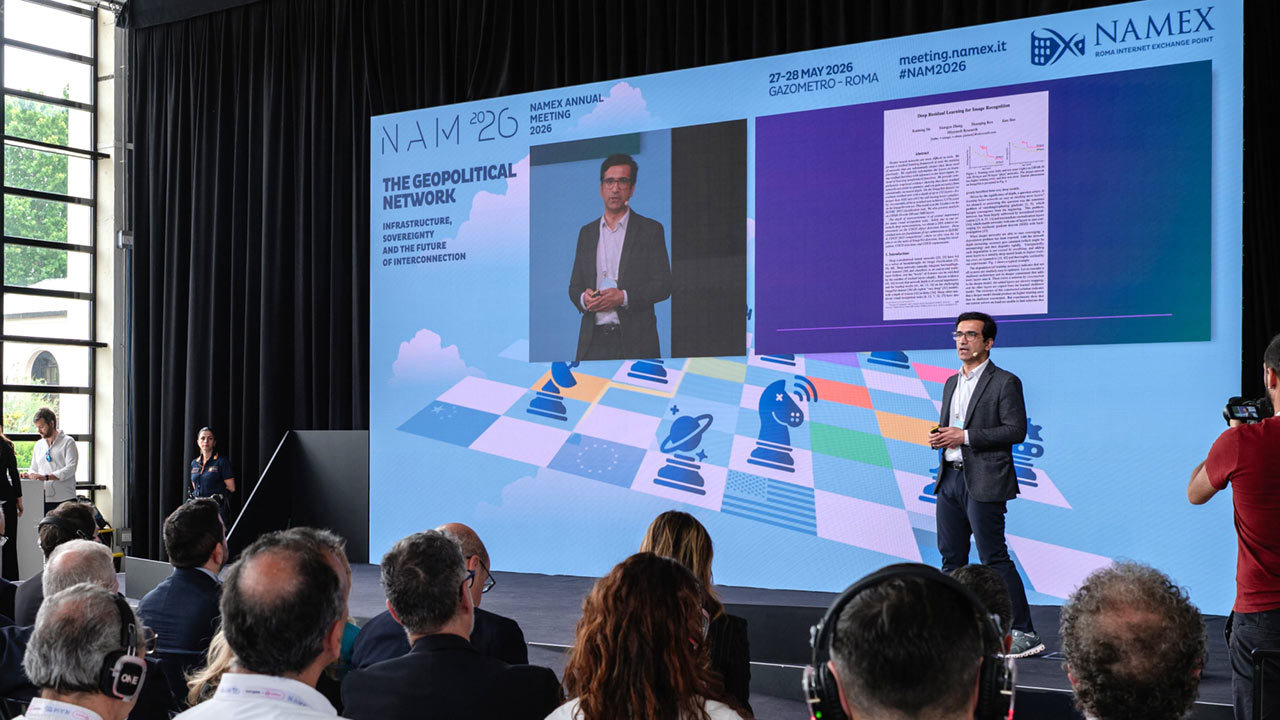
Mehran Gul, author of “The New Geography of Innovation” and a speaker at NAM2026, explains why Europe’s lag in AI and frontier technologies is also a story of companies, capital and talent lost. The first challenge is not to produce more, but to stop what is born in Europe from growing up elsewhere.
[Editor’s note. The wording has been preserved in English, with light punctuation, capitalization and readability edits only. Proper names have been standardized.]
The United States and China are racing ahead, and Europe is increasingly lagging behind. What are the main indicators of this problem for Europe?
So, I just talked in my presentation about, for instance, the world’s most important AI conference, which happens to be in Europe. If you look at the percentage of papers that were accepted from various institutions around the world, only 1% were accepted from an institution within the EU, and only about 4% from institutions in geographical Europe. That really shows you how the continent is positioned when it comes to competing in frontier areas.
The question is not just that the output at present is not where it needs to be. It is also that whatever is being produced is very quickly being lost to other places. If you look at some of the most important companies that have come from Europe in the past 20 years, many of them are no longer in Europe or have been acquired by foreign players. UiPath is not in Romania anymore. Hugging Face is not in France anymore. DeepMind is now a division within Google. I think these are both some of the causes and the consequences of Europe not competing at the level that it ought to.
Where can we find our best chances to catch up, or at least to find a European way of innovation in this new geopolitical order?
I think the first step really ought to be to retain what Europe already has. If you go to universities today, the culture still is that people are either trying to move to the US, trying to sell their companies to American players, or getting investments from American VCs, not European VCs. So before we get to the question of how Europe does more than it is doing right now, the question really ought to be: how does it retain the output that it is already producing, but losing to other places?
And then, after that, I don’t think Europe is really there when it comes to attracting top talent from around the world. If you look at the US, despite all the pushback against China, you go to top American tech companies and the plurality of the talent base still comes from Chinese institutions. That is something I don’t see in Europe today: this active competition to try to find the best people from around the world and get them to come and work in Europe.
We were talking about immigration earlier. I think the unfortunate fact is that immigration into Europe today is still economic migration. It is not talent migration. So how does that conversation move in that direction? Just one important last fact: most of the reason why the US is competitive in tech is because it imports its talent, not because it produces its own talent. It is simply a fact that over half of households in San Francisco speak a language other than English at home. So how can Europe show up in that competition for global talent, rather than limiting the immigration debate to economic migration?
Link to the interview: https://youtu.be/fTe_6MdHN2k?si=i5hwC0nOkJ4fVvOp