
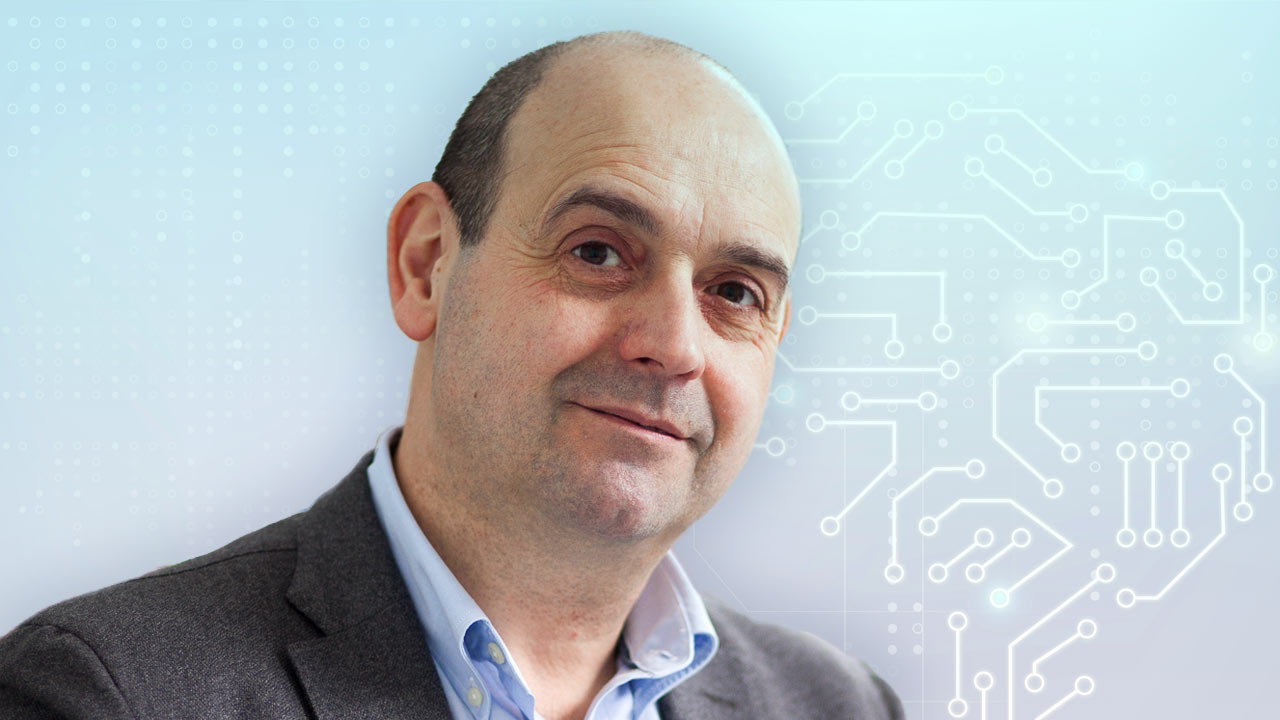
Antonio Baldassarra now looks at AI the way someone who has already lived through a major tech revolution: the cloud revolution. It is a perspective worth having. It helps one imagine the shape artificial intelligence will ultimately need to take for those of us who, like Italians, do not create this technology at the foundational level.
The founder of Seeweb, an Italian cloud provider, recalls what the mood was like in 2010, the years when cloud still seemed like a bet, not the invisible infrastructure now underpinning nearly everything digital, AI included. “We are facing a technological leap that will define the next ten, twenty years, just as that one did,” he says. The difference is that today, on artificial intelligence, he believes we are running in the wrong direction.
History, once again, provides lessons. Seeweb, his creation, was founded in 1995 as an Internet provider, back when connectivity meant the screech of a modem and the web was still frontier territory. First an ISP, then web hosting in 1998, then cloud in 2009: “We were among the first Italians to do it, modeling ourselves on AWS and GoGrid, which were the American pioneers at the time.” It is a story of infrastructure: servers and data centers built piece by piece as the network grew around them.
AI entered this trajectory almost sideways. Baldassarra began watching OpenAI back in 2020, when ChatGPT did not yet exist and the name was circulating mainly among insiders (ChatGPT’s global debut would come at the end of 2022). Seeweb tried to launch a GPU cloud-as-a-service offering, but the project never took off. “We only picked it back up recently,” he says, “algonside an inference provider product using both open-source and custom models.” It is not merely about renting compute: the idea is to offer companies an application layer where models fine-tuned on their own data, not everyone’s data, can run.
The real value space, for companies like his and more broadly for European players, is not trying to chase the giants on generalist models, those built “for everyone and everything.” This is Baldassarra’s central point. What is needed is the development of many “Private AIs”: private, vertically focused artificial intelligences tailored to specific domains such as medicine, pharma, biotech, and social sciences. “Competing on generalist models in Europe and Italy is very difficult,” he admits. “But in certain sectors (especially pharma, biotech, and medtech, where confidentiality is paramount) models tuned to the microcosm of a specific company can make a real difference.”
He envisions them like this: systems trained on all of a company’s internal documents, with meticulous data quality control, a well-defined perimeter, and consequently a much narrower margin for error. In drug discovery, for example, a private AI working on proprietary databases and integrated with RAG-based document retrieval could significantly reduce the time needed to identify the most promising drug candidates. An assistant that knows intimately the language, the rules, and the institutional memory of a given organization.
This concept of a “homegrown” AI is something Seeweb is already testing internally, in a far more prosaic domain: trouble ticketing. The system reads customer support requests, helps draft an appropriate response, often clearer and better written than what a technician might produce, and simultaneously returns a sentiment score for the conversation. The technician does not only see the content, but also a kind of emotional thermometer: is the customer frustrated? About what, exactly? Is there something to adjust in the tone or the way things are explained?
Baldassarra had assumed tools like these would mainly help “lift” the less skilled, those with greater difficulty writing or communicating. “I believed they would help them the most,” he admits. “Then I realized I was wrong: they work better with people who are already competent, because those people know how to validate the output. AI gives an extra gear to those who already have the fundamentals; it doesn’t hand them to those who don’t.”
Conversely, Baldassarra regards with skepticism the multi-billion-dollar investment plans being announced across Europe for dedicated AI infrastructure. He speaks of “fluid” technology (fluid on both the hardware and software sides) and of industrial plans that look too far ahead. “I see investments in the fantastillions with timelines stretching more than a decade,” he says. “Meanwhile, AI is changing so fast that we risk building cathedrals in the desert.”
The metaphor he uses is that of the apartment blocks of the 1950s. “Today we think about AI the way we thought about those apartment blocks back then. We made a spectacular miscalculation: we’ll end up with mega-investments that have no future, assuming they even get built. A data center takes years to activate and amortize, and in those years the technology moves on.” Predictions that Italy’s dedicated data center capacity would grow tenfold, from 0.5 gigawatts to 5 gigawatts over ten years, with revenues multiplying tenfold or twentyfold, strike him as barely credible. “Nothing like that has ever happened in history, especially when you consider that if energy demand explodes, the price of energy will likely rise too.”
In his view, it would make more sense to concentrate efforts on two fronts: research into more efficient algorithms and experimentation with alternative hardware technologies. “We are in a phase of great inefficiency,” he insists. “We still use the same silicon gate logic as thirty years ago, the one invented by Faggin. Far more promising technologies exist, such as memristors or certain silicon junctions with air gaps, which were not economically viable until now because they were too expensive. It may now make sense to invest in them.”
The same applies to current algorithmic approaches. Google’s Transformer architecture remains the reference point, but experiments like China’s DeepSeek show there is ample room to make models lighter, less energy-hungry, and more adaptable. “In ten years, I don’t think we’ll be using the same amount of energy or the same amount of floor space as today,” he says. “In the history of technology, things have never stood still. Maybe fewer chips will be needed, less space; perhaps a significant portion of intelligence will migrate to the network edge.”
In this scenario, Baldassarra also sees a role for a European foundation model champion. He cites Mistral as the only player that perhaps has a genuine chance of competing with the major American and Chinese players. He does not envision an Europe full of mini-OpenAIs, each locked within its own perimeter, but rather a convergence of forces around a few robust projects, while the real value for operators like Seeweb is played out closer to companies, in concrete implementations and in Private AI.
How well this vision will take root domestically remains to be seen. “I see an enormous problem on the demand side,” he says. “It is a strange demand, oriented almost entirely toward generic solutions: Copilot, ChatGPT, and the like. Everything, including regulation, casts us as users of the AI revolution, not as participants in it.” In other words, Italy (and to some extent Europe) risks becoming accustomed to the idea of consuming technology built elsewhere, of “subscribing” to artificial intelligence developed by others, rather than building its own, at least in certain segments.
There is a fundamental immaturity in our approach to AI. The point is echoed by the latest EIB Group Investment Survey 2025 (covering approximately 13,000 companies surveyed across the EU, from the European Investment Bank). Only 20% of Italian companies report systematic use of generative AI tools, against an EU average of 37%. The picture is somewhat better for AI in the broader sense, including big data analytics, where traditional (non-generative) AI carries more weight.
For Baldassarra, the alternative path requires a leap toward maturity, toward what truly serves our economy. Less generic use, more concrete Private AI projects embedded within companies.
The game now is a collective one. It requires tech players like Seeweb to help shape AI to the real needs of Italian companies; but it also requires those companies to be receptive: to move beyond superficial trends and genuinely integrate AI into their processes.
— By Alessandro Longo, Journalist