

NAMEX NEWSLETTER | DECEMBER 2025

CONSORTIUM
When growth becomes cooperation

— By Maurizio Goretti, Namex CEO
The closing of the year represents, for Namex, a moment of reflection and synthesis. It is an opportunity to take stock of the activities carried out and, at the same time, to look with greater clarity at the directions that are taking shape.
2025 was a year of intense work, marked by the consolidation of infrastructure and services, as well as by concrete growth of the community. During the year, around 30 new ISPs connected, a new traffic record was registered (1.4 Tbps), and we reached the highest number of services delivered in Namex’s history.
These are important results, confirming the solidity of the model and the trust of the community. They rest on daily work that is often barely visible, yet essential.
Alongside the historic Rome node, 2025 also confirmed the growth path of the territorial hubs. Namex Bari and Namex Napoli recorded a significant increase in interest and participation, strengthening the footprint in Southern Italy and contributing to an ecosystem that is increasingly distributed, resilient, and close to operators.
Beyond the numbers, the year reiterated how much the community dimension is an integral part of the infrastructure itself. Meeting and discussion activities saw growing participation, starting with the RMNOG beers and the BariNOG appointments, which have consolidated themselves as spaces for technical and human dialogue.
The great success of the event dedicated to space fits within this path, broadening the perspective on the future of networks while keeping the role of Internet Exchange Points at the center.
It is precisely from this experience of growth, relationships, and trust that ARGO was born.

NAMEX OBSERVATORY
How Live sport actually gets to your screen: inside the infrastructure behind Serie A streaming
— By Flavio Luciani, Namex CTO

REGULATORY POLICIES
The CHAT CONTROL proposal: status of the legislative process and next steps
— By Innocenzo Genna, Legal specialist in EU digital policy, competition and liberalization regulations
INTERNET BEYOND EARTH
The next Internet Exchange Point might be on the Moon: space Is the new network layer
— By Christian Cinetto, Head of Communication and Content at Namex
“Magnificent desolation.” First words on the lunar surface. Buzz Aldrin, 1969
“IP on Earth, DTN in Space.” Vint Cerf, 1998
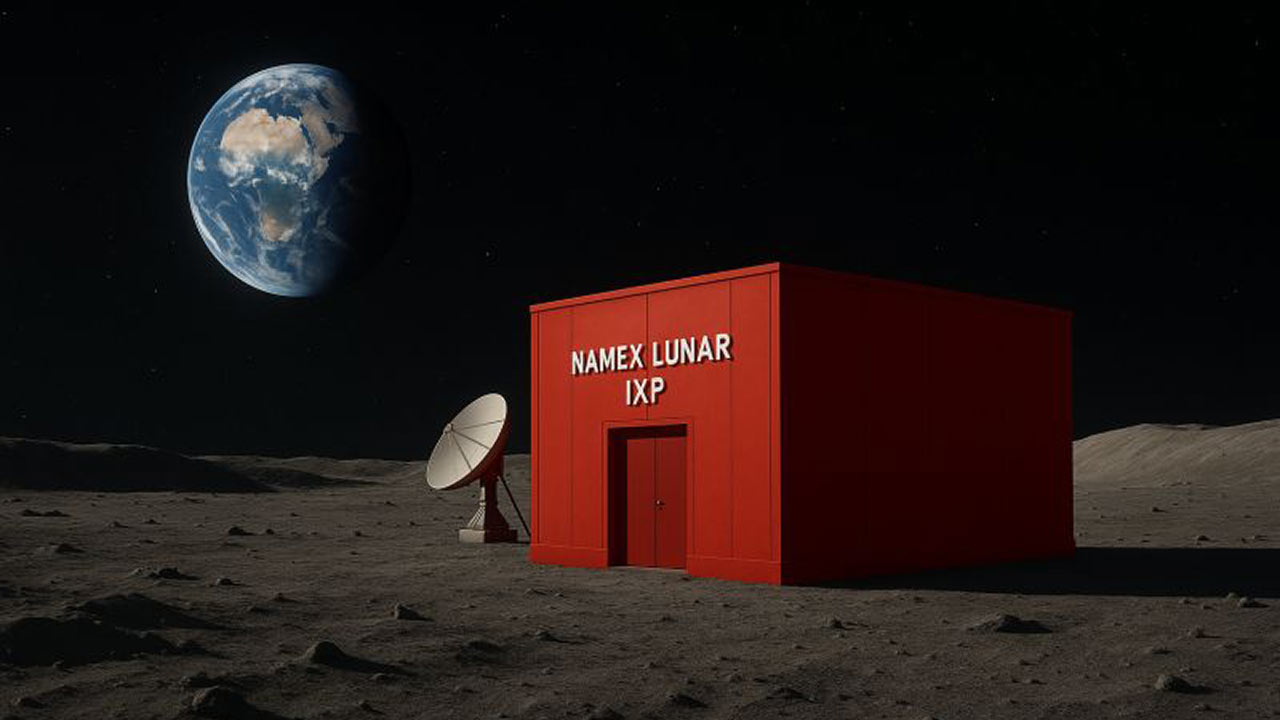
This article was born from a paradox, or rather, from a joke that reality ricocheted into something we had to take very seriously. Last April Fools’ Day, with AI’s help, I generated an image of a lunar data center: the “NAMEX Lunar IXP.” It was supposed to be a gag, a bit of fun for our community. But as often happens when technology outruns imagination, we realized that April Fools’ prank wasn’t a meme. It was a vision. At NAM in June, we discussed space with ESA, D-Orbit, and astronaut Paolo Nespoli, and we grasped how tangible the space network and its implications have become. If until yesterday we looked at submarine cables as the vital arteries of the internet, today we need to learn to look up.

COMMUNITY STORIES
From a roman garage to the depths of the Mediterranean: Unidata turns 40
— By Alessandro Longo, journalist
From a Roman garage to the depths of the Mediterranean; from selling computers to laying submarine cables: a journey spanning half a century. With the same thread running through it all: curiosity for innovation, attention to people. “And courage, yes, that too: without it, you need to find another line of work…” Renato Brunetti watches his Unidata, of which he is one of the founders, turn forty in 2025. If the company were a person, you’d say: it has entered the age when you start to understand life. When you play at the adults’ table. Looking at what Unidata has done so far, but especially at what it has begun to aspire to, the analogy seems to hold.
So, forty years. What happened? How did we get here?

Monthly Photo
Three years of RMNOG: what started as an experiment is now a monthly gathering bringing together hundreds of colleagues around Rome’s internet community.

JANUARY
January 20 RMNOG, Roma
January 26 BARINOG, Bari
FEBRUARY
February 5 Anix Meeting 2026, Tirana
February 17 RMNOG, Roma
February 26 Assemblea consorziati NAMEX, Roma
News
NEWS from NAMEX and surroundings
Namex in the media
» Space internet: the IXP protocol for the Moon (article, Wired.it, 12/12/2025) “Bringing the internet beyond Earth’s orbit is no longer science fiction. At the ‘Internet Beyond Earth’ event, organized by NAMEX in Rome, participants discussed how to adapt Internet Exchange Point principles to lunar and interplanetary communications.” wired.it
» Internet on the Moon? It’s not science fiction (article, key4biz.it, 05/12/2025) “This is the sentiment emerging from the event organized today by NAMEX, Internet Beyond Earth, held at the headquarters of the Italian Geographical Society at Villa Celimontana. A discussion that focused on Italy’s and Europe’s role in developing future space networks and interplanetary communication protocols.” key4biz.it
» Internet Exchange: Italy’s first service federation is born (article, CorCom, 10/12/2025) “ARGO is born, the first service federation among Italian Internet Exchange Points. The initiative, launched by TOP-IX and NAMEX, pools infrastructure and expertise to offer operators, content providers, and businesses ‘a shared ecosystem of connectivity and advanced services, with particular attention to the needs of small and medium-sized ISPs…'” corrierecomunicazioni.it
» Italy now has a federation for faster and more resilient internet services (article, Wired Italia, 12/12/2025) “The ARGO initiative, presented on December 10 by the consortia managing two of the most important Internet Exchanges in our country… aims to create a service federation… ‘Italy doesn’t suffer from major delays and fiber presence is above the European average,’ explains Maurizio Goretti, CEO of NAMEX… ‘What’s needed is to ensure that the services businesses require are available… and that infrastructure guarantees adequate performance.'” wired.it
Namex highlights
» On November 18 in Rome, “The Journey of Streaming Soccer” brought together over 100 attendees, eager to explore a highly complex supply chain. The protagonists walked through the glass-to-glass process: Vincenzo Roggio (DAZN) explained how the video stream originates and the strategic role of caches; Philippe T. (MainStreaming) demonstrated how the CDN replicates and distributes matches; Flavio Luciani (NAMEX) illustrated what an IXP sees during sports traffic peaks; Giulio De Nicola (Fastweb) described what happens inside an ISP’s network when millions of users connect simultaneously. Watch the full recording on our YouTube channel.
» “Internet in Space,” the event NAMEX organized on December 5 at Villa Celimontana in Rome, featured participation from ESA, IPNSIG, Leonardo, and Telespazio. The sessions were moderated by journalist Emilio Cozzi. Interviews and the full event recording are available on our YouTube channel.
» “3 years of RMNOG… Community growth: 2023: 199 participants; 2024: 435; 2025: 642 participants. Mailing list: 400+ subscribers… Thanks to our sponsors, partners, and everyone in the RMNOG community… A special thank you to NAMEX, which supports the growth of the Roman community every day.” Thank you RMNOG
» NAMEX has strengthened its commitment to the internet as a global public good by joining the Internet Society as a Bronze Level Organization Member. Supporting ISOC means actively contributing to the priorities, strategy, and governance of the multistakeholder model. NAMEX pro ISOC
» For the first time, NAMEX participated in Peering Asia. CTO Flavio Luciani delivered a presentation on the evolution of internet traffic profiles and volumes in the era of big content. NAMEX’s presence responds to the growing interest among Asian operators and content players in the Mediterranean as an interconnection hub, interest already evident at Capacity Europe. Link
» NAMEX supports the IXP ecosystem, starting with national ones. We were pleased to participate in VSIX and support the event as Gold Sponsor. NAMEX VSIX
» Our Christmas greetings to the community, NAMEX-style, with a small surprise, wishing growth and success to all our consortium members. Greetings from NAMEX
News from the Internet world
» AMS-IX exits the United States, pivots to emerging markets
AMS-IX will shut down its U.S. operations on March 5, 2026, decommissioning its points of presence in the Bay Area and Chicago. The Dutch internet exchange announced the decision as part of a comprehensive review of its global strategy. The focus now shifts to emerging markets in Asia, the Middle East, Africa, Latin America, and also Europe and the Mediterranean.
The group recalls arriving in the U.S. in 2013 to bring the European internet exchange model, neutral and open, to American soil. Now, however, the assessment is that it can have greater impact elsewhere: AMS-IX currently operates 15 active Internet Exchanges across four continents and aims to strengthen its role in the new hubs of data traffic growth.
To ensure continuity for connected operators in the United States, the company has arranged a migration path to partner Megaport, with the stated goal of making the transition “seamless.” In parallel, AMS-IX announces the launch of new value-added services, starting with an Accurate Time Services offering expected in early 2026, a sign that the repositioning is not a downsizing but a reallocation of resources toward segments and regions considered more strategic.
For the Mediterranean area and Europe, the news confirms the important new role this region is assuming on the chessboard of global interconnections.
Read more
» EU Commission rejects dynamic blocking: Piracy Shield deemed an isolated and ineffective model
An evaluation published by the European Commission calls into question the effectiveness of dynamic blocking systems against online piracy and directly addresses the Italian case of Piracy Shield. Despite rapid injunctions and cooperation among national authorities, piracy of live events and streaming content has decreased only marginally at the European level.
Brussels describes a fragmented and slow chain of responsibility, with hosting providers often outside EU jurisdiction and private intermediaries reluctant to cooperate. In this context, Italy is described as an exception: Piracy Shield, managed by AGCOM, requires national internet providers to block illegal streams within 30 minutes, but leaves key players outside its scope, including major international CDNs, public DNS services, OTT platforms, and satellite providers.
The result is an asymmetric mechanism that burdens Italian ISPs with obligations and costs without effectively reducing the phenomenon, with piracy simply shifting to channels not intercepted by national rules. The Italian Internet Providers Association (AIIP) continues to call for distributed responsibility along the entire supply chain and greater investment in legal offerings, which the Commission itself considers a decisive factor in reducing demand for illicit content.
Read more
» Piracy Shield: operators demand a €9.5 million annual fund
The fight against online piracy is proving expensive for electronic communications operators, and now Italian internet providers are seeking compensation. The provider association AIIP proposes establishing a fund of €9.5 million per year to cover the costs incurred in operating Piracy Shield, the AGCOM platform that enables rapid blocking of illegal streams, originally created for pay soccer and later extended to films, TV series, and live music.
AIIP reports that the entire technical, organizational, and administrative burden of the system currently falls on Italian operators, who are required to perform complex interventions within extremely tight timeframes, without any financial compensation. A situation described as anomalous compared to other European countries and potentially distortive of competition, especially for small and medium-sized providers.
The association’s proposal includes resource allocation criteria based on a fixed portion and a variable portion linked to the number of active lines, both fixed and mobile, on a progressive basis. The goal is to ensure sustainability for smaller operators without placing excessive costs on larger ones. Asstel, the telecommunications association, takes a similar position, speaking of the need for a “new universal digital service” and emphasizing how ISPs have been transformed into guardians of network legality without participating in the economic value chain of content.
Read more
» Two Cloudflare outages in two weeks reignite alarm over internet fragility
Two service interruptions in two weeks, with repercussions across the global internet. Cloudflare’s recent troubles bring a perennial topic back to center stage: the excessive concentration of internet infrastructure. The outages (between late November and early December 2025), caused by technical errors, had an immediate impact on corporate portals, fintech apps, e-commerce sites, and a long list of services that rely on the company’s content delivery network, DNS, and edge security.
Experts like Richard Ford (Integrity360) and Ryan Polk (Internet Society) warn of the risks of entrusting an ever-growing share of global traffic to a small number of large CDN and cloud providers. When one of these nodes goes down, whether due to internal error, a botched update, or an attack, the domino effect can affect thousands of organizations across entirely different sectors.
The issue isn’t limited to Cloudflare: there was also a recent incident in AWS’s US-East-1 region that triggered cascading DNS problems. Hence the call for businesses to adopt more robust resilience strategies: multi-CDN setups, hybrid clouds, fallback paths, and distributed architectures that avoid single points of failure. According to experts, without this paradigm shift, every new blackout will continue to reveal how fragile the foundation of the digital economy has become.
Read more
» Brussels prepares AI “gigafactories”: bidding to open in early 2026
The European Union is preparing to deploy a new instrument to close the gap with the United States and Asia in artificial intelligence infrastructure: the so-called “AI gigafactories.” According to the Wall Street Journal, Executive Vice-President for Technology Henna Virkkunen announced that the call for project proposals will launch between January and February 2026 and remain open until summer.
The gigafactories are expected to house large-scale computing capacity for training and running advanced AI models. Brussels acknowledges, however, that it does not yet have a European supply chain for the most sophisticated chips: for this reason, at least in the initial phase, the necessary GPUs will have to be purchased outside the EU, primarily from U.S. suppliers.
The Commission is finalizing the legal framework that will govern the projects, including criteria for state aid and requirements for energy efficiency and sustainability. In the background, the political objective is twofold: strengthen European “technological sovereignty” and reduce dependence on major American hyperscalers, while recognizing that, at least in the medium term, complete autonomy in hardware and platforms will remain difficult to achieve.
Read more
» Submarine cables and space: Butti says “new sovereign territories must be defended immediately at the EU level”
Submarine cables and space infrastructure are no longer mere technical components but “new sovereign territories” to be protected like terrestrial ones. That’s the message from Alessio Butti, Undersecretary to the Prime Minister’s Office with responsibility for Innovation, speaking in Rome at the “Space & Underwater: Space Economy, Submarine Cables & Cybersecurity” conference.
Butti stressed the urgency of a coordinated European response on security, regulation, and investment, noting that Europe lags behind the United States and Asia on both frontiers: submarine links, crucial for global data traffic, and space, where satellite constellations and orbital infrastructure are becoming key nodes for digital services as well.
The undersecretary urges Brussels to accelerate concrete protection measures, from critical infrastructure surveillance to common response mechanisms in case of attacks or sabotage. The issue intersects with dossiers on digital sovereignty and the space economy: without a secure network of cables and space assets, Butti warns, European competitiveness in the digital sector risks further erosion.
Read more
» AGCOM equates CDNs with telecom networks; six associations protest: “It’s a disguised network fee”
AGCOM’s decision to bring content delivery networks (CDNs) within the scope of electronic communications networks is igniting a fierce clash between the digital industry and the regulator. A letter signed by six international associations, from the Business Software Alliance to Euroconsumers to InnovUp, calls on the Meloni government to halt the resolution extending the general authorization regime under the Electronic Communications Code to CDNs.
According to the signatories, CDNs do not perform the same role as telcos: they transport traffic privately on behalf of content and application providers and do not directly serve end users. The equation, they argue, risks effectively introducing a “network fee” for distributing content that users have already paid for, in conflict with commitments made by the EU to the United States not to introduce network usage tariffs.
The associations warn of potential negative effects on investments, startups, and digital SMEs, as well as on essential public services that rely on CDNs to handle traffic spikes and ensure security. Asstel, the telecommunications association, takes the opposite view, arguing that AGCOM’s move aims to rebalance regulatory asymmetries between telcos and major content distribution intermediaries, in line with the forthcoming European digital networks legislation.
Read more
» Urso: “With national strategy, Italy can become Europe’s data center hub”
Minister of Enterprises and Made in Italy Adolfo Urso claims credit for Italy’s shift on data centers and explicitly aims to make the country a European hub. In remarks reported by Agenzia Nova, the minister, speaking in Milan on November 24, emphasized how the country has “changed significantly” since the start of the legislative term, thanks to a national strategy that puts infrastructure for data processing and storage at its center.
“In an international context characterized by geopolitical tensions, by wars both military and commercial, by challenges related to tariffs and energy costs, Italy’s role is crucial. The Meloni government is operating effectively, everyone acknowledges this, thanks to institutional stability that is also indispensable for investment,” he added.
What emerges is the idea of an industrial policy that considers data centers strategic infrastructure on par with telecom networks and cloud, with the goal of attracting investment and strengthening European data sovereignty. The ambition is to position Italy as the reference node in the Mediterranean for digital flows, also leveraging submarine cables landing on the country’s coasts and interconnections with other European hubs.
What remains to be seen is which concrete instruments, whether incentives, streamlined procedures, or agreements with major operators, will accompany this strategy and how it will be balanced with energy efficiency and environmental sustainability objectives, increasingly central to the data center debate.
On this topic, a bipartisan legislative proposal has been sitting in the Chamber of Deputies for over a year. “Urso preaches well but practices poorly,” said Giulia Pastorella (Azione) after the minister’s remarks, accusing the government of delays in advancing the bill.
le parole del ministro, accusando il Governo dei ritardi subiti dalla proposta di legge.
Read more
» Orbital data centers: big tech’s new challenge at the intersection of AI and space economy
Putting data centers in space to power artificial intelligence with nearly continuous solar energy and reduce pressure on water and land resources on Earth. That’s the scenario big tech is beginning to explore. In particular, the competition between Jeff Bezos and Elon Musk is now extending to the idea of transforming low Earth orbit into an extension of the cloud economy. Google is also in the game, with plans for initial orbital computing experiments in 2027.
The promise is infrastructure that processes data “on board,” minimizing downloads to Earth and thus eliminating some of the bottlenecks of terrestrial networks. But the technical challenges are far from trivial: heat management in the absence of atmosphere, system reliability, launch and maintenance costs, and, not least, space debris management.
Around orbital data centers, regulatory and geopolitical questions also arise: who controls data processed outside the atmosphere, which law applies, how to ensure infrastructure security, and how to prevent new concentrations of power in the hands of a few global players. For now, the project remains in a pioneering phase, but big tech’s interest indicates that space could become the next frontier, not only for telecommunications but for the entire data economy.
Read more