
“Magnificent desolation”. First words on the lunar surface. Buzz Aldrin, 1969
“IP on Earth, DTN in Space” Vint Cerf, 1998
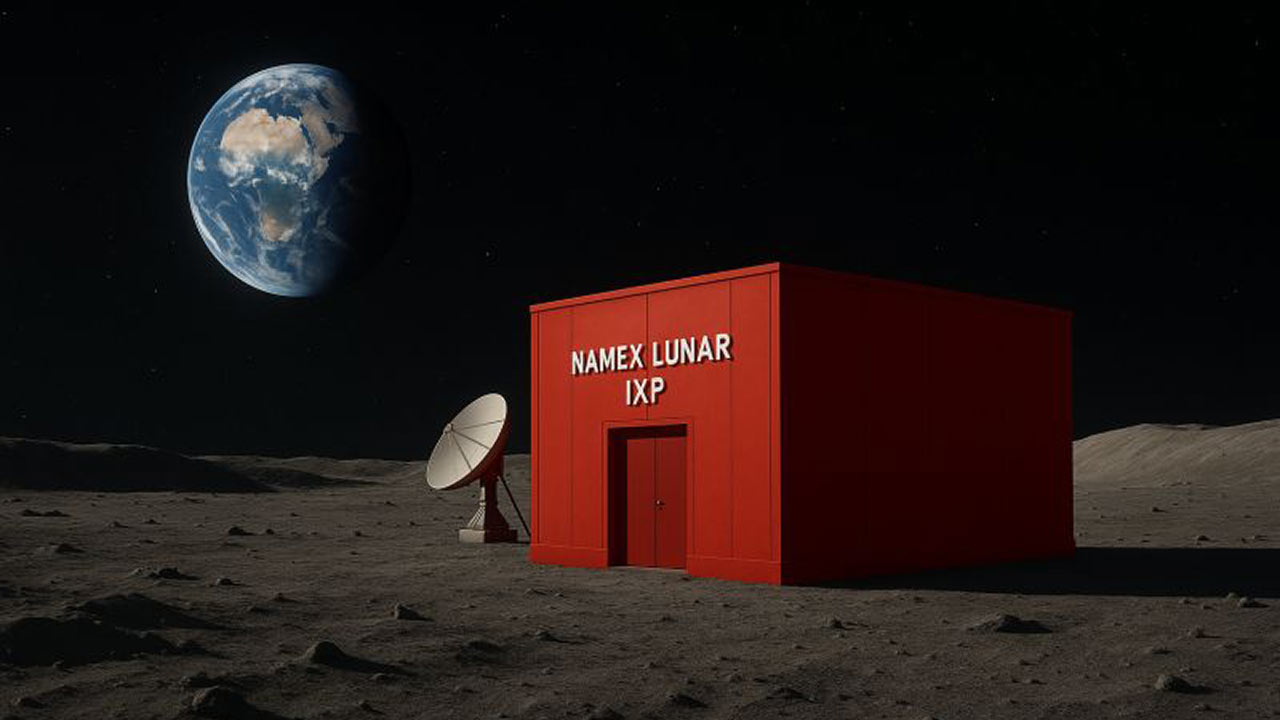
This article was born from a paradox, or rather, from a joke that reality ricocheted into something we had to take very seriously. Last April Fools’ Day, with AI’s help, I generated an image of a lunar data center: the “NAMEX Lunar IXP.” It was supposed to be a gag, a bit of fun for our community. But as often happens when technology outruns imagination, we realized that April Fools’ prank wasn’t a meme. It was a vision. At NAM in June, we discussed space with ESA, D-Orbit, and astronaut Paolo Nespoli, and we grasped how tangible the space network and its implications have become. If until yesterday we looked at submarine cables as the vital arteries of the internet, today we need to learn to look up. The convergence between terrestrial and satellite telecommunications is underway, and understanding it will become a strategic necessity for anyone operating in the world of the internet.
From the headquarters of the Italian Geographical Society at Villa Celimontana, with our “Internet Beyond Earth” event, we tried to take an even more ambitious step: what kind of internet awaits us in space? Will it be a splinternet of proprietary networks governed by the private interests of a handful of trillion-dollar companies or equally powerful autocratic governments? Or are there other paths?
Moonlight and the proprietary cable syndrome
If on Earth we’re surprised that Lidl is building its own cloud for digital sovereignty and economies of scale, in space we’re witnessing a similar awakening. Until recently, every lunar mission brought along its own communications apparatus. A bit like every company having to lay its own fiber optic cable just to send an email. Inefficient, expensive, unsustainable. Felix Flentge from ESA told us about the Moonlight project: building a shared network around the Moon. A kind of lunar “provider” aiming for serious infrastructure rationalization. Are we moving from planting flags to doing routing?
Houston, we still have a problem
If we apply our terrestrial standards to the space frontier, we hit an insurmountable limit: physics. Between Earth and the Moon, there’s an average latency of 2 to 3 seconds. For Mars, we’re talking minutes. The internet is a network that works well on Earth, or as some would say, “good enough.” But the TCP/IP protocol it’s built on is impatient: if it doesn’t get a response immediately, it times out. On Earth, that works. In space, TCP/IP fails. This is where DTN (Delay/Disruption Tolerant Networking) comes in, as explained by Keith Scott from IPNSIG. When we think of the word “connection,” we imagine a continuous flow of information. DTN forces us to rethink it as a chain of “digital mules” that guard the packet until the next node becomes visible. From “fire and forget” to “store and forward when you can.” It’s a paradigm shift that’s mental before it’s technical.
Orbital edge computing: processing in the void
Another insight comes from cloud computing. Marco Brancati from Leonardo and Nicola Pizzolorusso from Telespazio showed us how satellites will no longer be simple mirrors bouncing signals. They’re becoming orbiting data centers. If a satellite is observing Earth looking for wildfires, it makes no sense to send terabytes of photos of healthy forests to a server in Frankfurt. It needs to process the data on the edge, up there, and only bother us with the alert.
Swept up in the allure of limits and frontiers, a crucial question arises: can we Italians compete in this field? The answer is yes, if we stop thinking of data centers only as warehouses full of servers and start thinking of them as distributed computing nodes everywhere, including in orbit. And if we recognize that our country has hosted space excellence for 60 years, often in niche areas, that we can build into a system.
NAMEX and its consortium members can decide whether to be spectators of this new digital solar system or to go further and become a fundamental piece of it. It’s not so different from the bet our pioneers made in the early ’90s when they crossed four wires at Sapienza University in Rome. Thirty years later, NAMEX has become one of the most important Internet Exchange Points in the Mediterranean, growing from 4 to 300 connected networks.
Contributing to the evolution of the internet requires a deep understanding of the underlying infrastructure. Being a neutral exchange point gives us the privilege of seeing the signals of change as they emerge. What we saw at Villa Celimontana is that space data also needs to be interconnected, to land somewhere and take off again. Orbital peering and space cloud are already very concrete topics, and if we start now, we’re in time to study the trajectory and maybe contribute to a space IXP, whether orbital or lunar.
“Space is for everybody. It’s not just for a few people in science or math, or for a select group of astronauts. That’s our new frontier out there.” Christa McAuliffe, teacher aboard the Space Shuttle.
The full video of the event and interviews with the speakers are available on the NAMEX YouTube channel.
— By Christian Cinetto, Head of Communication and Content at Namex